

‘Mastermind’: When the Keepers of Truth Become Its Most Unreliable Witnesses

Louis Koo stars as Maximo, a brilliant but unconventional detective whose pursuit of the truth places him at the center of a deadly conspiracy in Mastermind (2026).

Simon Yam commands the screen with quiet authority as the Chief Inspector in Mastermind (2026).
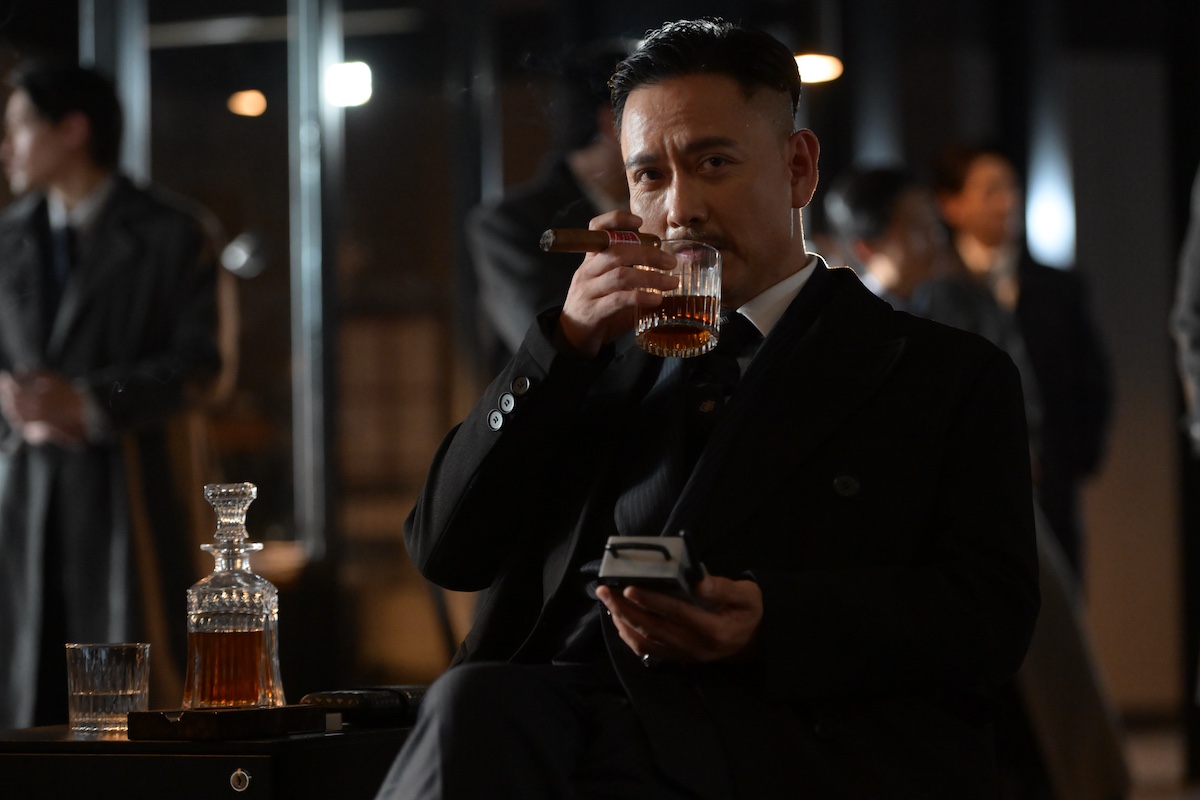
Tse Kwan-ho brings a commanding intensity to his role as the Deputy Commissioner of Intelligence in Mastermind (2026).
James L.J. Hung’s Hong Kong crime thriller explores how a mysterious murder exposes the fragile boundaries between truth, evidence, corruption, and power.
LOS ANGELES, CA, UNITED STATES, October 30, 2026 /EINPresswire.com/ -- The most disturbing possibility in Mastermind (偵戰) is not that someone has committed an impossible murder. It is that the murder may be perfectly explicable to people who have no interest in explaining it. Beneath its elaborate detective puzzle, James L.J. Hung's film presents a world in which the distinction between knowing the truth and possessing the authority to declare it has become dangerously uncertain. That distinction, more than the identity of any criminal, gives this strange Hong Kong thriller its lingering unease.The story begins with two ostensibly secure spaces: a police detention cell from which a suspect inexplicably disappears, and a locked archive where his body is subsequently discovered. The investigating officer, Maximo (Louis Koo), finds himself implicated by a bullet associated with his own weapon.
There is something almost philosophical about the symmetry. One room fails to contain a person; another fails to protect the integrity of its official function. Both belong to institutions built around the assumption that security, surveillance and procedural control can establish an objective account of events.
Yet the greater the appearance of control, the more radical the failure becomes.
What interests me about these rooms is not their mechanical ingenuity but their relationship to institutional certainty. A detention cell should eliminate ambiguity about someone's whereabouts. An archive should preserve the past against the uncertainty of memory. When those functions become unreliable, the crisis extends beyond the immediate crime.
If the state cannot guarantee what occurred inside its most controlled environments, what grounds remain for trusting the narratives it produces about events outside them?
Maximo must therefore confront more than the challenge of proving his innocence. The institutional world in which he has constructed his professional identity can suddenly produce an entirely different version of who he is.
But what happens when the information itself is subject to manipulation?
The film raises an uncomfortable limitation of rational expertise: reasoning correctly is not equivalent to determining which facts are available for examination. Intelligence becomes vulnerable when the conditions under which knowledge is produced are controlled by others.
That idea resonates beyond the criminal intrigue. In societies increasingly organized around databases, surveillance and technical expertise, the struggle is not always over what can be known. It is over who decides what counts as knowledge.
The archive becomes the film's most suggestive metaphor.
We regard archives as neutral repositories where facts survive the distortions of recollection. But an archive is also a system of selection, classification and access. Someone decides what deserves preservation, who may consult it and which procedures establish credibility.
By situating a murder within such a space, Mastermind introduces a disturbing contradiction: the institution charged with preserving evidence becomes itself a source of uncertainty.
The past need not be erased. It may remain intact, carefully stored and inaccessible, while those authorized to interpret it construct something else.
The film's social observations sharpen this unease.
Its fictional city is populated by smaller exchanges of influence: gestures of hospitality outside a police station, the cultivated discretion of private clubs and routine conversations among senior officials. Together, they suggest relationships governed by obligations that rarely appear in official records.
Their ordinariness matters.
Corruption in popular thrillers frequently announces itself through extraordinary villains or spectacular betrayals. Mastermind is more unsettling when it suggests that compromised institutions may function perfectly well on the surface.
An exchange of favors resembles politeness. A private understanding appears indistinguishable from professional courtesy. Influence need not involve an explicit threat.
It is tempting to read this as an anxiety about Hong Kong's relationship with authority, although the fictional setting does not justify reducing the film to a direct political allegory. Its concerns are more productively understood through questions of bureaucratic power, social hierarchy and the uneasy coexistence of public responsibility and private loyalty.
What makes such a system frightening is not that everyone must be corrupt. It is that individuals may accommodate its contradictions while continuing to regard themselves as decent.
The film's absurd humor reinforces this interpretation. When officials behave with ridiculous self-importance or professional rivalries descend into petty exchanges, the comedy reveals how abnormal circumstances become absorbed into everyday routines.
We laugh at the disproportion between the seriousness of the situation and the triviality of the behavior. Then the implications become less amusing.
The film is less convincing when its elaborate conspiracy overwhelms these quieter observations. Scientific explanations, psychological manipulation and successive reversals sometimes introduce an ingenuity disproportionate to the human questions beneath them.
There is an intriguing contradiction here. A film concerned with the instability of truth sometimes makes its own account of events unnecessarily difficult to evaluate. Ambiguity permits competing interpretations; obscurity deprives viewers of sufficient evidence to form one. Mastermind does not consistently maintain that distinction.
Nevertheless, I find its unresolved moral implications more compelling than the prospect of a perfectly explained mystery.
A conventional detective story offers reassurance: disorder enters the world, intelligence restores causality, and the revelation of the criminal reestablishes the authority of reason.
Mastermind troubles that arrangement.
Exposing individual wrongdoing does not guarantee that the structures enabling it have fundamentally changed. An investigation may identify culpability without repairing the conditions that allowed an official account to become unreliable.
This is not necessarily a hopeless worldview. It simply recognizes the difference between solving a crime and restoring trust.
The former demands an answer. The latter demands confidence that those responsible for producing answers can themselves be held accountable.
Perhaps this is why the film's recurring concern with doors remains so evocative. A door separates the authorized from the excluded, those who can inspect evidence from those expected to accept its interpretation. An ordinary architectural feature becomes a boundary between different kinds of power.
I left Mastermind less concerned with whether every ingenious mechanism withstands scrutiny than with the question it leaves behind: if truth depends upon institutions that cannot fully account for themselves, what does it mean to trust an explanation?
That is not a puzzle any detective can solve alone.
Kevin Park
Cloqué
Legal Disclaimer:
EIN Presswire provides this news content "as is" without warranty of any kind. We do not accept any responsibility or liability for the accuracy, content, images, videos, licenses, completeness, legality, or reliability of the information contained in this article. If you have any complaints or copyright issues related to this article, kindly contact the author above.
